
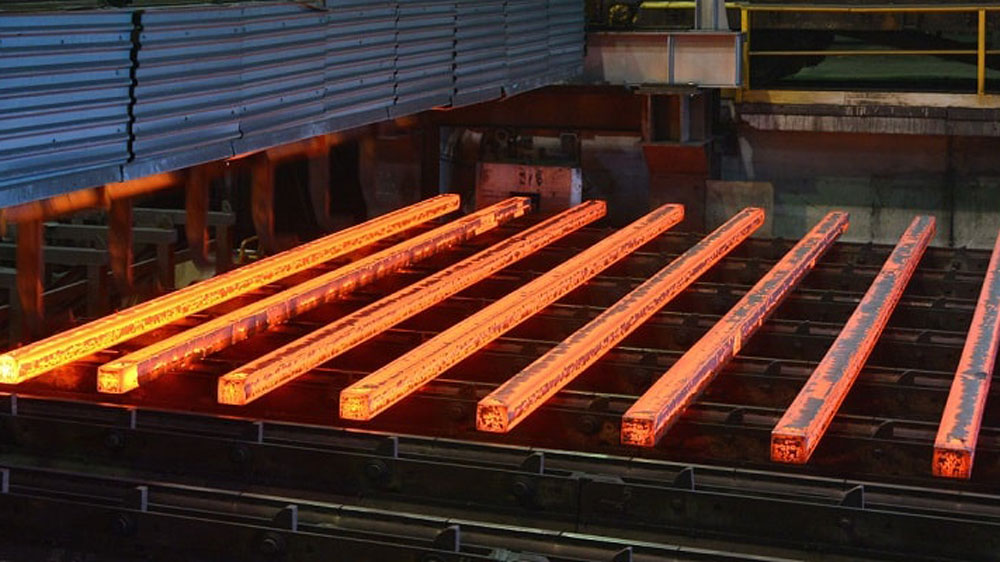
Steel ingots are one of the most practical types of ingots in the world. A study of history shows that ingot making was first done during the Achaemenid era; but ingot making was not only related to the Achaemenids, and ancient discoveries show that the use of gold and silver ingots as money was widespread in the world. We have all probably seen pyramids of gold ingots in movies or recorded images from major world banks; yellow gold ingots in the form of a tetrahedral prism stacked like bricks, such an image is the most visual definition of ingot that can be expressed; but one of the most correct definitions is given by Merriam-Webster:
“A volume of metal produced in the form of a specific mold in the casting process to make it easier to transport, store, and use the metal.”
The steel industry chain is directly dependent on steel ingots. Steel ingots are used in the production of rebar, beams, sheet metal, and other items, but the ingot itself is not directly converted into such products; rather, it is an intermediate product of steel production that is converted into rebar, beams, and….
Intermediate products of steel production that are produced from steel ingots are:
Billet
Bloom
Slab
In this article, we intend to learn more about the types of ingots and provide information about how to produce billets, produce blooms, and produce slabs. Please stay with us until the end of the article.
What is a billet?
A billet is one of the semi-finished products in the steel industry that is used as a raw material for the manufacture of steel parts such as rebar, beams, and angles. The ingot is usually round or square, with a diameter of 15 cm and a length of different lengths. This product is produced through a continuous casting or molding process and is widely used in many manufacturing and industrial companies due to its high strength and durability. In general, the quality of the billet has a direct impact on the performance and strength of the final product, and the right choice can increase productivity.
What is a bloom?
A bloom is the same as a steel ingot, except that its surface is square and its dimensions are different. When the desired ingot is produced with dimensions of 150*150 mm, 200*200 mm or 260*260 mm, it is called a bloom. Also, a bloom has a length of 12,000 mm. With these interpretations, a bloom is the same as a billet, only in terms of dimensions, length and rolling process for its preparation and production, it becomes a bloom.
What is a slab?
A slab is another steel product that is produced from a steel ingot. Slabs have a rectangular surface and a length of 4 to 12 meters and are used in the manufacture of steel sheets. Slabs are used as a raw material for the production of steel sheets and are usually obtained by continuous casting. Due to their flat and wide surface, this product is the main basis for the production of hot-rolled and cold-rolled steel sheets such as black sheet, oil sheet and galvanized sheet. Due to its high quality, this sheet is used in various industries such as automotive, construction, home appliances and steel pipe manufacturing. Choosing a board with appropriate specifications will have a significant impact on the quality and performance of the final products.
What is the difference between ingot, billet, bloom and slab?
It was mentioned in the introduction that the steel industry chain starts with iron ore and many alloys available in the metal market depend on this mineral, therefore the hardness and price of steel are directly related to iron ore. The reason for stating this is so that we know that all ingot, billet, bloom and slab products depend on iron ore. Today, the price of iron ingots in the market changes with the price of iron ore.
Ingots are the first product produced from iron ore. Ingots are brick-shaped products produced by continuous casting. The length of ingots is 2 meters and they are produced as pure metal.
What is billet?
Billets are one of the most popular products of intermediate steel rolling and are produced with circular and square cross-sections. The longer length of billets compared to ingots has led to the use of billets in the production of rebar and wire (products that require longer lengths). The width of the billet is less than 15 centimeters. Billets are produced in the 3sp and 5sp groups, the differences between which are as follows:
3sp billets have higher flexibility (stretching and bending) than 5sp billets.
5sp billets have higher strength than 3sp billets.
Applications of steel ingot types
As you know, there are different types of steel ingots, and their applications will also vary depending on the type of ingot. The diagram below shows the different applications of billets, blooms, and slabs.
Types of steel ingot production methods
Steel ingots are produced in two furnaces: induction and electric arc:
Production of steel ingots using a blast furnace
The blast furnace method is a common method for producing steel ingots. In this method, iron ore is fed into the blast furnace along with scrap iron. Oxygen is used to melt these materials, which is called the “oxygen-based” melting process. In this process, oxygen enters the furnace through two spear-shaped pipes. Oxygen enters the furnace at twice the speed of sound, and then heating begins. One of the products of the blast furnace is slabs, which was mentioned that the price of slabs is directly related to the price of iron ore.
Adding oxygen causes oxidation, which will lead to the destruction of impurities. Lime is added to the furnace to absorb impurities during the process. The lime and impurities react and produce slag.
Steel produced in the open oxygen furnace method is discharged from the converter cavity.
Advantages of the blast furnace:
Impurities are well separated.
Possibility of high-volume production.