
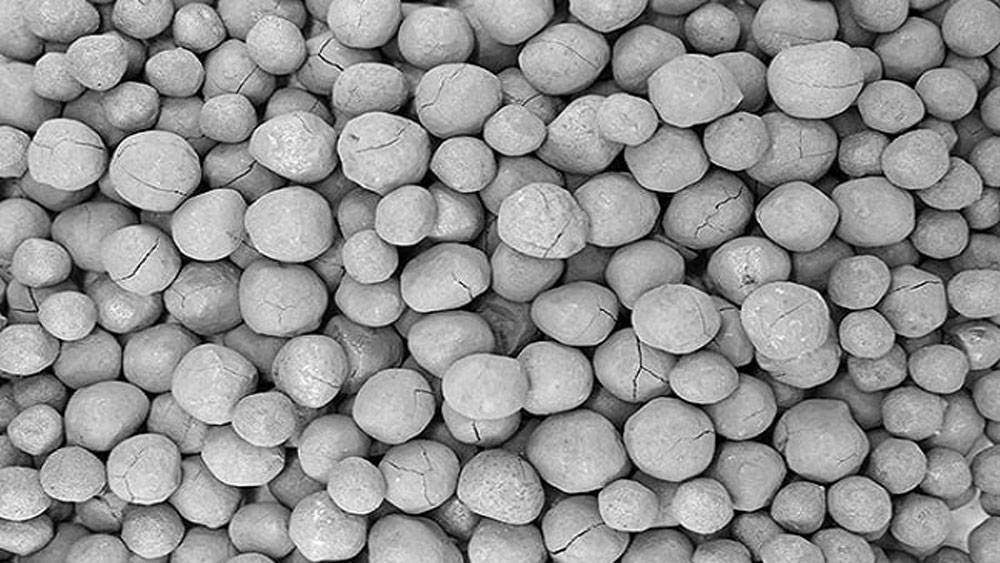
What is sponge iron?
Sponge iron or DRI (direct reduction iron) is a material that is obtained from the reduction of iron ore (in the form of lumps, pellets or scrap) directly, that is, without melting. During the direct reduction process, due to the release of oxygen gas, the iron ore is transformed into spherical pieces that have small holes on their surface like a sponge. This appearance characteristic is the reason for the special name of this product.
The grade of sponge iron is between 84 and 95 percent, which is considered a high value. The table below shows the chemical composition and density of this steel product in two different forms, lumps and fines.
In recent years, more than 5 percent of the world’s steel consumption has been obtained from this type of iron. Given the high level of air pollution, environmental problems in other iron production methods, and the more affordable price of sponge iron, it is expected that the use of this product will increase in the future.
Methods of sponge iron production
Iron production by direct reduction, from which sponge iron is obtained, is newer than other iron production methods and its emergence in the world dates back to the 1970s. In direct reduction methods, the reducing agent used can be coal or natural gas, although the use of coal has a longer history.
The following technologies are used to produce sponge iron using natural gas:
• Midrex
• HYL
• Purofer
Of these three technologies, Midrex and HYL are the most widely used and most efficient.
In the Midrex method, iron ore with a grade of 67% is reduced without the need for an intermediary and using cracked gases. In this way, natural gas is decomposed in the gas cracking unit by heat and special catalysts, releasing hydrogen and carbon monoxide. Then these two gases enter the reduction furnace, combine with the oxygen in the molten iron, and the iron ore is reduced, resulting in high-grade sponge iron. The sponge iron produced at a temperature of 600 degrees Celsius is transferred to electric arc furnaces (EAF) for purification, and steelmaking operations begin on it. In the HYL method, in addition to using cracked natural gas as a reducing agent, steam is also used to increase the amount of hydrogen produced. Therefore, in this method, the amount of hydrogen is much higher than carbon monoxide and plays the role of the main reducing agent. The reduction furnace is similar to the Midrex furnace, but the reaction pressure is set at a higher level (7 atmospheres) so that the reactions can be carried out at the desired speed.
The following methods are also used to produce sponge iron using coal:
Tunnel furnace method
SL/RN
The tunnel furnace has a long and elongated structure made of refractory bricks and special rails are placed on its bottom. The process designed in this furnace includes three stages of preheating, reduction and cooling, respectively. The primary iron in powder form passes through this tunnel and is placed in the vicinity of coal and is reduced by the heat generated by burning natural gas with oxygen from the air.
The SR/NL method is one of the oldest reduction processes and its idea is taken from the horizontal kiln used in cement production. In this furnace, thermal coal is combined with coal as a reducing agent and sponge iron is produced.
What is the Midrex method for producing sponge iron?
The most practical and widely used method for producing sponge iron is the Midrex method. To produce sponge iron using this method, natural gas is first fed into the gas cracking unit and, after receiving heat and undergoing a complex process, is converted into hydrogen and carbon. The hydrogen and carbon obtained from natural gas are fed into an induction furnace or reduction furnace to be combined with iron ore pellets that have been previously cooked in the furnace to reduce iron ore and produce sponge iron.
The Midrex method has been widely used in these respects, as it can bring the highest possible efficiency to the producer by minimizing gas consumption. Currently, in Iran and the world, sponge iron production is achieved in most cases by relying on this method. An important question that may arise is what is the main difference between the Midrex and HYL methods for producing sponge iron? The answer is short and clear; very high electricity consumption and limited production capacity are the two main reasons.
What is the difference between a reduction furnace and a Midrex furnace?
Another method of producing sponge iron is to use the HYL method; in this method, using fractured natural gas, other factors such as steam are also used to produce more hydrogen. However, in the HYL method, the amount of hydrogen is higher than the amount of carbon monoxide produced, which can lead to direct reduction of iron ore. The reduction furnace has a similar function to the Midrex furnace, but the ambient pressure will be higher (equivalent to 7 atmospheres).
What are other methods for producing sponge iron?
Other methods used to produce sponge iron include the tunnel furnace and SL/RN methods. Tunnel furnaces are very long and include 3 stages of preheating, iron ore reduction and cooling. In this method, iron ore will enter the furnace in crushed form and is so-called reduced by being placed next to coal and exposed to the heat generated by burning natural gas with oxygen.
But what is the SL/RN method for producing sponge iron? In this method, instead of using natural gas, coal is used to reduce iron ore to produce sponge iron using horizontal furnaces.
What are the advantages of using sponge iron?
As we said, about 5% of the world’s ironware market is